How Long Does It Take to Get Monetized on YouTube? An Honest Answer
By The iamcreator.io Team · August 2, 2026
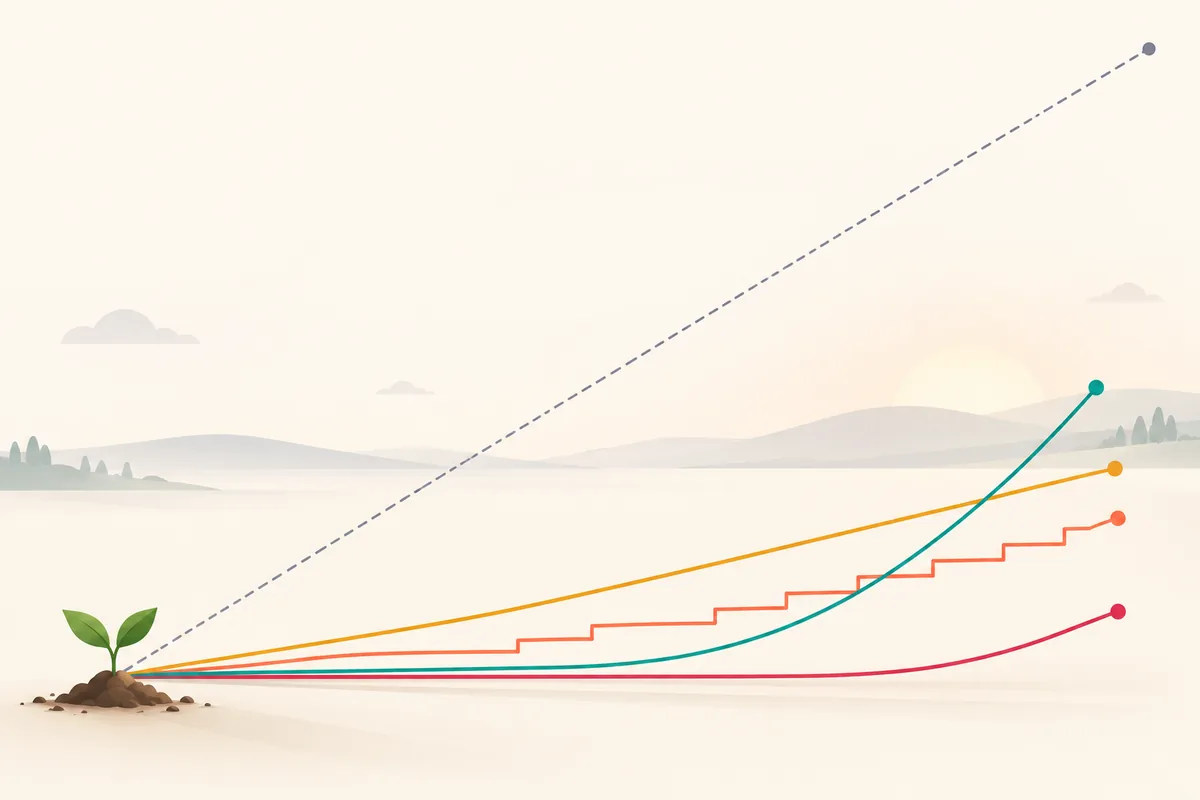
How long does it take to get monetized on YouTube? You’ll find confident answers everywhere: six months, two years, “most channels take about 18 months.” Push on any of them and the source evaporates. The truthful version is less satisfying and far more useful: the timeline isn’t a statistic you look up, it’s an arithmetic problem with four inputs — and three of those inputs are yours to change.
What you’re actually racing toward
Two locks, and both have to open. Full monetization requires 1,000 subscribers plus either 4,000 valid public watch hours in the past 365 days or 10 million valid public Shorts views in the past 90 days. There’s also an earlier door — at 500 subscribers, with 3 public uploads in the last 90 days and either 3,000 watch hours or 3 million Shorts views, you can switch on fan-funding features like memberships and Super Thanks while you keep climbing toward ad revenue.
Notice what’s missing from that list: any mention of time. YouTube never asks how long you’ve been at it. A channel that opened yesterday and a channel that’s been grinding for four years face exactly the same bar. That’s good news, mostly — but it also means nobody can hand you a date, because the date is a function of your numbers, not the calendar.
The four things that actually decide your timeline
1. Niche and search demand
The single biggest variable, and the one people obsess over least. A video answering a question people actively type into search keeps earning views for years; a video about a passing trend earns for a weekend. Against a rolling 365-day requirement, that difference compounds enormously. Small niches with real, unmet demand are consistently faster than big niches with a thousand competitors, because your video only has to be the best answer for a small group rather than the twentieth-best for a huge one.
2. Cadence
Not because “the algorithm rewards consistency” in some mystical sense, but because each upload is another ticket in the draw and another permanent contributor to your back catalogue. Four videos a month gives you four chances a month for something to land. One video a month gives you one. Over a year, that’s the difference between 48 chances and 12.
3. Format and length
Watch hours are views multiplied by how long people stay, so a channel averaging 12 minutes of watch time per view needs roughly a third of the traffic of a channel averaging 4 minutes. Same finish line, wildly different amounts of audience required. If you want that laid out properly, it’s all in 4,000 watch hours = how many views? — 4,000 hours is 240,000 minutes, and everything else is division.
4. Where you started
A creator who brings an audience from somewhere else — a podcast, a newsletter, an existing following — starts the race halfway down the track. Someone starting from a genuinely cold audience does not. Both can get there; comparing your month three to their month three is comparing two different races.
Why extrapolating a small channel’s pace is nonsense
Here’s a confession. Our own analyzer used to take a channel’s recent growth rate, divide the remaining gap by it, and print the resulting date. For a channel with momentum that’s genuinely useful. For a channel that gained two subscribers last month, it produced results like “monetized in the year 3157.” The math was flawless. The answer was garbage.
And it’s garbage for a specific, non-obvious reason: small channels don’t grow linearly. They sit flat, and flat, and flat — and then one video finds an audience and the curve steps up to a completely different level. Every number before that step is a terrible predictor of every number after it. Extrapolating from a standstill doesn’t forecast your future; it just measures how still you currently are, in units of centuries.
When a projected date does become useful
Four scenarios (not statistics)
Since honest averages don’t exist for this, here’s the next best thing: four made-up-but-realistic channels, with the arithmetic shown so you can swap in your own numbers. These are illustrations of the math, not research findings — the point is the shape of each one, not the exact figures.
| Scenario | Uploads / month | Views per video | Avg view duration | Watch hrs / month | Time to 4,000 hrs |
|---|---|---|---|---|---|
| Weekend hobbyist | 1 | 150 | 3 min | ~8 | Not on this trajectory |
| Consistent beginner | 4 | 300 | 4 min | ~80 | ~4 years if nothing improves |
| Search-led niche channel | 8 | 600 | 6 min | ~480 | ~8 months |
| One video breaks out | — | 50,000 (once) | 5 min | ~4,166 in one hit | Crossed in a single upload |
Three things fall out of that table. First, the hobbyist row isn’t slow — it’s impossible, because at 8 hours a month the rolling window drops old hours as fast as new ones arrive. That channel never approaches 4,000 no matter how many years pass. Second, the “~4 years” row is exactly the projection that shouldn’t be believed: it assumes video number 200 performs like video number 4, which is almost never how it goes. And third, the breakout row is why nobody can quote you an average with a straight face — a single upload can rewrite the entire timeline.
What about the 1,000 subscribers?
The subscriber lock usually gets less attention and often takes longer. There’s no fixed views-to-subscribers rate, but your own channel has one, and it’s sitting in Studio right now. Do the division: if roughly 1 viewer in 100 subscribes, 1,000 subscribers means about 100,000 views; at 1 in 250, 250,000 views; at 1 in 500, half a million.
That ratio is not fixed either — it climbs sharply when a channel has an obvious reason to subscribe, meaning a clear topic, a recognisable format, and a promise that the next video will be more of the thing you just enjoyed. Channels that scatter across unrelated topics convert badly, because there’s nothing specific to subscribe to. The practical playbook for this half of the requirement is getting your first 1,000 subscribers from zero.
See exactly which lock is still closed
Enter your subscribers, watch hours, and Shorts views to check every monetization path at once — including the 500-subscriber early-access tier.
The rolling window nobody warns you about
The 4,000 hours must sit inside the trailing 365 days, and that window moves forward every day. So there’s a threshold pace beneath which you can upload forever and never arrive: if hours expire off the back faster than you add them at the front, your total plateaus and then drifts down. Creators in that position often assume the counter is broken. It isn’t — it’s telling them, accurately, that the current rate isn’t a route to monetization.
This is also the honest reason “just be consistent” is incomplete advice. Consistency at 8 watch hours a month is consistency at losing. Consistency at 400 is a plan. The number that matters is your pace against the window, and you can check yours against the target in the watch hours calculator.
The shortcut that resets your clock
What actually shortens the timeline
- Longer videos people finish. Every extra minute of average view duration reduces the traffic you need, and traffic is the expensive part. The tactics are in the best way to get 4,000 watch hours.
- Topics with existing search demand. Evergreen videos keep paying into the rolling window for years instead of dying in a weekend.
- A cadence you can hold for a year. Four sustainable uploads a month beats a heroic twelve followed by a two-month disappearance. If recording is the bottleneck, narrating your own scripts in a clone of your own voice — our sister tool Voice has a free plan — keeps the schedule without cutting corners, as long as the scripts stay yours (why that matters).
- One clear topic per channel. It raises subscriber conversion and gives YouTube an audience to recommend you to.
- Playlists and end screens. Turning one arrival into three views is the cheapest watch time in existence.
- Fixing the metadata you control. Titles, descriptions, tags and chapters won’t save a bad video, but a good video with a weak title quietly loses months of reach. Run one through the video SEO checker and see.
After you qualify: the last wait
Crossing the thresholds isn’t the finish line — you still apply, and YouTube reviews. That review usually takes about a month, and it can run longer when volumes are high. It’s a policy check as much as a numbers check: reused content, misleading metadata, or active Community Guidelines strikes can hold you up even with the counters full. You watch the status in Studio under the Earn tab, and if you’re turned down you can fix the problems and reapply after 21 days. Worth building that month into whatever date you’re planning around.
Stop guessing, start executing
The reason “how long does it take?” is such a compelling question is that it feels like it should have an answer. It doesn’t — but the question underneath it does. What people really want to know is am I on a path that gets there at all, and what do I do this week? That one is answerable from your actual data.
That’s what the monetization roadmap is for: five stages from an empty channel to the Partner Program, with your channel placed in exactly one of them based on what your numbers say, and the next step you should take checked against real uploads rather than vibes. Once your channel is connected to iamcreator.io, it’s re-verified every week — steps you completed get ticked off on their own, and the projected date switches on automatically the moment you have enough pace to make one meaningful. Start by analyzing your channel; it takes about two minutes and doesn’t need an account.
The bottom line
How long it takes to get monetized depends on your niche, your cadence, your format, and where you started — not on an average somebody made up. Anyone quoting you a single number is selling comfort. Do the arithmetic on your own channel instead: how many watch hours a month you currently bank, how many views convert to a subscriber, and whether that pace beats the rolling window. Then work the one step that moves the slowest number. That’s the whole game, and it’s a lot shorter than waiting.
Frequently asked questions
How long does it take to get monetized on YouTube?
There is no fixed answer, and any specific average you see quoted is somebody's guess dressed up as data. What decides it is arithmetic: 1,000 subscribers plus 4,000 valid public watch hours in a rolling 365-day window, earned at whatever rate your videos actually earn them. A channel publishing weekly long-form videos that each find a few hundred viewers is usually looking at a year or more. A channel that lands one search-led topic with real demand can do it in a few months. A channel posting once a month to 150 views will not get there on that trajectory at all — not because it is too slow, but because the rolling window drops hours faster than it earns them.
What is the average time to reach 1,000 subscribers?
Averages are misleading here because the distribution is so lopsided — most channels never reach 1,000, and the ones that do are pulled up by a small number that get there fast. The useful way to think about it is conversion: if roughly 1 viewer in 100 subscribes, 1,000 subscribers means around 100,000 views; at 1 in 500, it means half a million. Look at your own views-to-subscribers ratio in Studio and the target becomes a real number instead of a folk statistic.
Can a small channel still get monetized in 2026?
Yes. The requirements have not moved — 1,000 subscribers plus 4,000 valid public watch hours in 365 days, or 10 million valid public Shorts views in 90 days — and there is now an earlier door at 500 subscribers that unlocks fan funding before ad revenue. What has changed is that thin, generic uploads get buried faster, so the small channels that make it tend to be the ones answering a specific question for a specific audience rather than making general content for everyone.
Can you get monetized in 3 months?
It happens, but it requires the arithmetic to work: roughly 44 watch hours a day plus enough subscriber conversion to hit 1,000 in the same window. That usually means either an existing audience you brought with you, a topic with strong search demand and little competition, or one video breaking out. It is not a plan you can promise yourself — it is an outcome you can make more likely by publishing videos that are long enough, findable enough, and frequent enough to give the breakout a chance to happen.
How long does YouTube take to review a monetization application?
YouTube says it usually reviews applications within about a month once you meet the thresholds and apply, though it can take longer during busy periods. You can watch the status in YouTube Studio under the Earn tab. If you are rejected, you can fix the issues and reapply after 21 days.
Do watch hours expire?
Effectively, yes. The requirement is 4,000 valid public watch hours in the past 365 days, and that window rolls forward every single day. Hours earned more than a year ago drop off the back of your total. A channel that has stalled will watch its watch-hours number fall while it is still uploading — that is not a bug, it is the window moving.
Is it faster to get monetized with Shorts or long-form?
It depends on which door you can actually reach. The Shorts path needs 10 million valid public Shorts views in 90 days, which is a lot of views in a short window; the long-form path needs 4,000 watch hours over a full year, which is far fewer views but demands that people stay. Shorts tend to bring subscribers faster and watch hours not at all, because Shorts watch time does not count toward the 4,000 hours. Many channels use Shorts for reach and long-form for hours, which is a legitimate strategy as long as you know which counter each one feeds.
Why does my projected monetization date look absurd?
Because linear projection breaks on tiny numbers. If a channel gained 2 subscribers last month, dividing the remaining 998 by that pace produces a date centuries away — technically correct, completely useless. Small channels do not grow linearly; they sit flat and then step up when something lands. Until there is enough pace to project from, the honest tool is not a date, it is a plan for what to do next.